
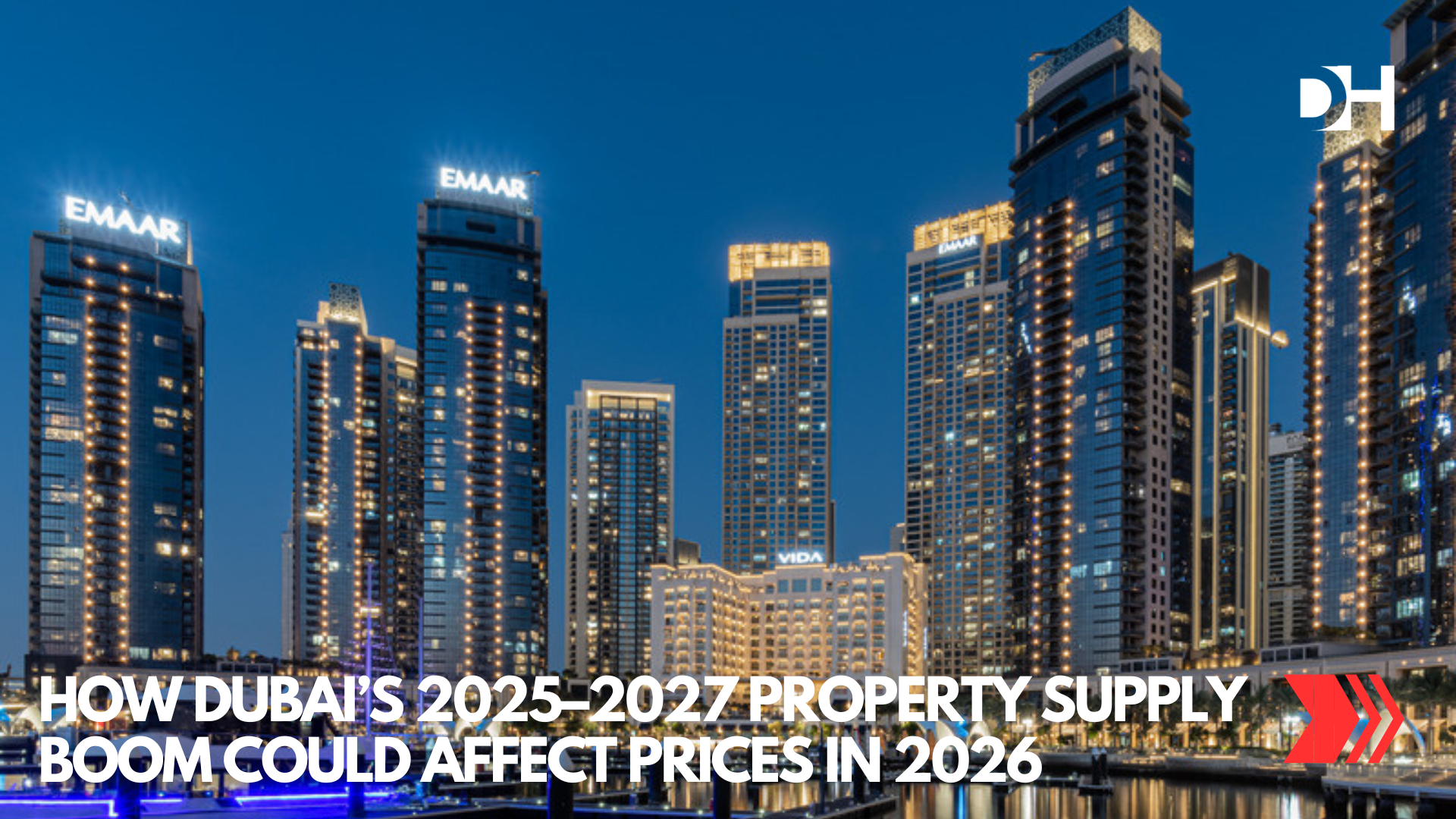
Dubai’s real estate market has enjoyed remarkable growth over the past few years, driven by strong investor demand, population growth, economic diversification, and government initiatives aimed at attracting global talent. However, as the emirate prepares for one of its largest property delivery cycles in recent history, many investors are asking an important question: How will Dubai’s 2025–2027 property supply boom affect prices in 2026?
With tens of thousands of residential units scheduled for completion between 2025 and 2027, the market is entering a new phase. While increased supply may create short-term pressure in certain segments, the overall impact on property prices will depend on factors such as demand growth, foreign investment, and economic performance.
Understanding Dubai’s Property Supply Pipeline
Dubai’s development landscape is currently witnessing a surge in new projects. Major developers have launched large-scale communities, waterfront developments, luxury residences, and mixed-use projects to meet rising demand from local and international buyers.
Industry forecasts suggest that tens of thousands of new homes will be handed over between 2025 and 2027. These include apartments, villas, townhouses, and branded residences spread across key areas such as Dubai South, Jumeirah Village Circle (JVC), Dubai Creek Harbour, Business Bay, Dubai Hills Estate, and Palm Jebel Ali.
This substantial pipeline reflects developer confidence in the market but also raises concerns about whether supply could eventually outpace demand.
Will More Supply Lead to Lower Prices?
In traditional real estate economics, a significant increase in supply can place downward pressure on prices if demand remains unchanged. However, Dubai’s market dynamics are unique.
The city continues to attract high-net-worth individuals, entrepreneurs, skilled professionals, and remote workers from around the world. Government policies such as the Golden Visa program, business-friendly regulations, and tax advantages have strengthened Dubai’s appeal as a long-term destination.
As a result, many analysts believe that while the supply increase may moderate price growth, it is unlikely to trigger a dramatic market correction across the city.
Instead, price movements may vary depending on location, property type, and quality.
Prime Areas May Remain Resilient
Luxury and waterfront communities are expected to remain among the strongest-performing segments in 2026.
Areas such as Palm Jumeirah, Downtown Dubai, Dubai Marina, and emerging luxury destinations continue to attract international buyers seeking premium properties. Demand in these locations often comes from cash-rich investors and end-users who are less sensitive to short-term market fluctuations.
Even with additional supply entering the market, prime assets may continue to command premium prices due to their limited availability and global appeal.
Properties with exceptional views, branded residences, and waterfront access are likely to maintain strong demand.
Mid-Market Communities Could Face More Competition
The greatest impact of the supply boom may be felt in the mid-market segment.
Communities such as JVC, Arjan, Dubai South, and parts of Dubailand are expected to see a substantial number of new units delivered over the next two years.
As developers compete for buyers and tenants, increased inventory could lead to:
- Slower price appreciation
- More flexible payment plans
- Attractive incentives from developers
- Greater negotiating power for buyers
For investors, this could mean a shift from rapid capital gains toward a more balanced market focused on rental income and long-term growth.
Rental Market Implications
Dubai’s rental market has experienced strong growth in recent years due to population expansion and limited housing availability.
The arrival of new residential units could help ease some of the pressure on rents in 2026. Tenants may benefit from a wider range of options, particularly in newly developed communities.
However, rental declines are not expected across the board. Areas with strong infrastructure, transportation links, schools, and lifestyle amenities are likely to maintain healthy occupancy rates.
In many cases, landlords offering modern properties with premium amenities may continue to attract tenants despite increased competition.
Population Growth Remains a Key Factor
One of the strongest arguments supporting Dubai’s property market is the emirate’s rapidly growing population.
Dubai continues to attract new residents through employment opportunities, entrepreneurship initiatives, and lifestyle advantages. The government has ambitious long-term plans to increase the population significantly over the coming decades.
If population growth remains strong, much of the upcoming supply could be absorbed without causing major price disruptions.
Demand generated by new residents, expatriates, and international investors may help balance the influx of new properties entering the market.
Opportunities for Investors in 2026
While some investors worry about oversupply, others view the 2026 market as an opportunity.
Increased inventory often creates better buying conditions. Investors may gain access to:
- Competitive pricing
- Flexible developer payment plans
- Higher-quality projects
- Attractive entry points in emerging communities
Long-term investors who focus on locations with strong infrastructure, transportation connectivity, and future growth potential could benefit from purchasing during periods of increased supply.
Rather than avoiding the market, many investors may use the supply boom as an opportunity to secure assets at favorable valuations.
What Buyers Should Watch
For buyers and investors considering Dubai property in 2026, several factors will be crucial:
Location Quality
Properties in established or strategically planned communities are more likely to retain value.
Developer Reputation
Projects from reputable developers often perform better during market fluctuations.
Infrastructure Development
Areas benefiting from new roads, metro expansions, schools, and commercial hubs may see stronger demand.
Rental Demand
Investors should assess tenant demand and projected yields before making a purchase.
Supply Levels
Understanding how much new inventory is entering a specific community can help identify potential risks and opportunities.
Outlook for Dubai Property Prices in 2026
Dubai’s 2025–2027 property supply boom is expected to reshape the market, but it does not necessarily signal falling prices across the city.
Instead, the market is likely to become more selective. Prime locations may continue to perform strongly, while mid-market communities could experience slower growth and increased competition. Buyers and investors may benefit from improved choice, better deals, and greater negotiating power.
Ultimately, Dubai’s strong economic fundamentals, growing population, and continued international appeal are likely to support long-term real estate demand. While the supply surge may moderate the pace of price growth, it could also create a healthier and more sustainable market environment for years to come.
For investors willing to take a long-term view, 2026 may offer some of the most attractive opportunities in Dubai’s evolving real estate landscape.
Read More
- Will Dubai Property Prices Increase in 2026? Expert Market Predictions
- Are Dubai Property Prices Falling in 2026?
- How to Set the Perfect Price for Your Dubai Property